
Natural Bobtail in Chihuahuas Contintuued
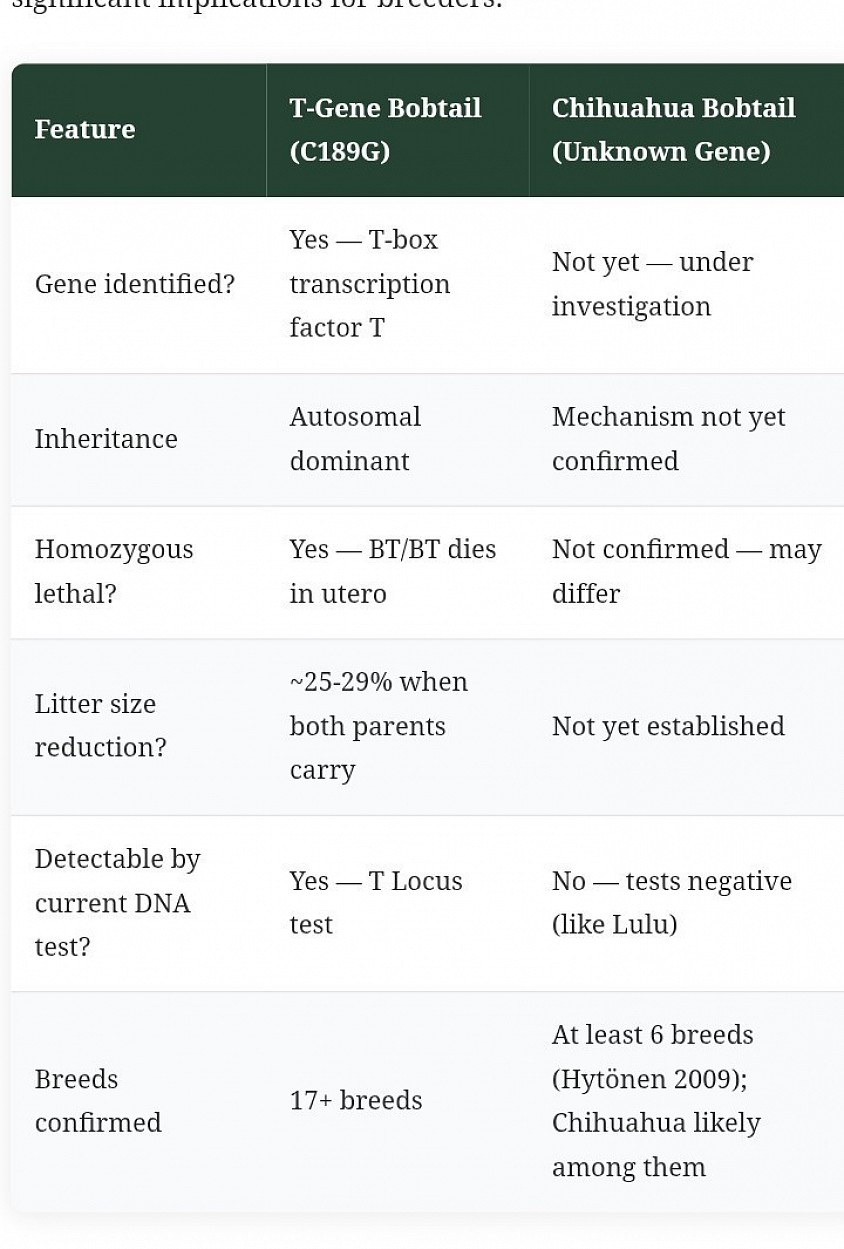
What This Means for Breeders Right Now
Because the gene responsible for Chihuahua bobtails has not yet been identified, we cannot yet test for it directly. A dog that tests t/t (like Lulu) on the standard bobtail panel is NOT carrying the T-gene mutation — but may still carry the unknown Chihuahua-specific bobtail gene.
Until the specific mechanism is identified and a targeted test becomes available, visual assessment and careful pedigree tracking remains the primary tool for monitoring this trait in breeding programs. This is one of the reasons participation in genetic research is so valuable.
the Chihuahua Bobtail a Health Concern?
Based on current observations, there is no evidence linking naturally short tails in Chihuahuas to health problems. Dogs like Lulu — bobtailed, t/t tested, and structurally sound — show no associated health issues from their shortened tails.
This is consistent with the fact that the Chihuahua bobtail appears to use a different genetic mechanism than the T-gene, which carries known risks when homozygous. Whether the unknown Chihuahua bobtail gene has any homozygous effects remains to be studied — and is one of the key questions future research needs to answer.
A Call to the Chihuahua Community: Help Solve This Mystery
Lulu's DNA certificate is one data point. To identify the gene responsible for bobtails in Chihuahuas, researchers need more data from more bobtailed dogs — especially dogs from old show lines where the trait is known to appear.
If you own a bobtailed Chihuahua, here is how you can contribute:
DNA test your dog for the T Locus through Paw Print Genetics or UC Davis VGL and share the results — especially if your dog is bobtailed but tests t/t (negative)Document your pedigree — note whether the bobtail appears in old show lines, and how many generations back it tracesContact canine genetic researchers — universities with canine genetics programs are actively seeking samples from breeds with bobtails of unknown genetic originPhotograph and measure tail length — detailed phenotypic records help researchers understand the range of expression
Every data point moves the science forward. Your bobtailed Chihuahua may hold the key to identifying a gene that has been quietly present in the breed for well over a century.
Key TakeawaysNatural bobtails are legitimate in Chihuahuas — the 1934 AKC breed standard explicitly states "Bob-tails and tail-less, so born, are not against a good dog." Bobtailed Chihuahuas were fully eligible to show and compete for nearly 70 years. It was the Chihuahua Club of America (CCA) — not the AKC — that added bobtail as a disqualification in 1972; the AKC ratified the parent club's decision, as it always doesBobtails cluster in old show lines — suggesting the trait came with the breed's European foundation dogs, not through recent crossbreedingIt is NOT the T-gene (Brachyury C189G) — Lulu's t/t DNA certificate proves this conclusively for at least one confirmed bobtailed ChihuahuaScience already knew unknown bobtail genes exist — Hytönen et al. (2009) confirmed that 6 breeds have bobtails not explained by the T-geneThe haplogroup data is revealing — 100% of tested Chihuahuas in the BreedGuru™ proprietary dataset carry European/West Eurasian haplogroups, including the ancient European C2 lineage, connecting these dogs to the same ancient European populations that also produced small bobtailed companion dogs like the Kelb tal-ButThe specific gene is not yet identified — current bobtail DNA tests will not detect it; this is an open and exciting area of canine genetics researchNo known health concerns — no evidence links naturally short tails in Chihuahuas to health problems, and the unknown gene does not appear to carry the same lethal homozygous risk as the T-geneYour participation matters — breeders and owners of bobtailed Chihuahuas can contribute meaningfully to identifying this gene through DNA testing and pedigree documentation
The Bottom Line
The natural bobtail in Chihuahuas is real, historically documented, and genetically distinct from the bobtail mechanism seen in most other breeds. It is not a sign of crossbreeding, a structural defect, or a disqualifying fault. It is a trait that has traveled with this breed's oldest lines — lines that, as haplogroup data increasingly suggests, trace their origins not to Mexico but to ancient European and Mediterranean dogs whose descendants helped shape the Chihuahua we know today.
Lulu's DNA certificate is a single, powerful piece of evidence pointing toward a larger truth that the Chihuahua community — and canine genetics researchers — are only beginning to explore. The gene responsible for this trait is out there, waiting to be found. And the breeders who have quietly been observing bobtails appear in their old show lines for generations may be the ones who help science find it.
Have a bobtailed Chihuahua? We'd love to hear from you. Reach out through our contact page to share your dog's pedigree, DNA results, or photos. Every piece of information helps build the picture.
References
American Kennel Club. (1934, August 14). Official Standard of the Chihuahua — Approved at Regular Meeting of the Board of Directors. AKC Archives. Tail section reads: "Bob-tails and tail-less, so born, are not against a good dog." Cropped tail only disqualification. Natural bobtail remained showable through the 1954 revision.
Kitako Kennels. (2024). Chihuahua History. Standard revised: 1934, 1954, 1972, 1990. https://www.kitacokennels.com/history-of-the-chihuahua
Thurmer, T. (1962). Pet Chihuahua. AKC breed standard documentation including recognition of natural tail variation.
Hytönen, M.K., Grall, A., Hédan, B., et al. (2009). Ancestral T-box mutation is present in many, but not all, short-tailed dog breeds. Journal of Heredity, 100(2), 236–240. https://doi.org/10.1093/jhered/esn085
Haworth, K., Putt, W., Cattanach, B., et al. (2001). Canine homolog of the T-box transcription factor T; failure of the protein to bind to its DNA target leads to a short-tail phenotype. Mammalian Genome, 12(3), 212–218.
UC Davis Veterinary Genetics Laboratory. (2024). Natural Bobtail (T Locus) Testing. https://vgl.ucdavis.edu/test/natural-bobtail
Paw Print Genetics. (2022). Coat Color and Trait Certificate — T Locus (Natural Bobtail), Lulu. Lab #329161, October 11, 2022.
Duleba, A., et al. (2015). Complete mitochondrial genome database and standardized classification system for Canis lupus familiaris. Forensic Science International: Genetics, 16, 44–54.
Bergström, A., et al. (2020). Origins and genetic legacy of prehistoric dogs. Science, 370(6516), 557–564.
Stringer, T.A. (Ongoing). The CM/SM Risk Lineage Study in Chihuahuas. BreedGuru™ Proprietary Master Dataset. A & A's Chihuahuas. All rights reserved.
Thalmann, O., et al. (2013). Complete mitochondrial genomes of ancient canids suggest a European origin of domestic dogs. Science, 342(6160), 871–874.
